Pages

Showing posts with label I/D. Show all posts

Thursday, March 20, 2014

I/D #3: Unit Q - Pythagorean Identities

Inquiry Activity Summary:

1) sin² θ + cos² θ = 1
According to some higher truth, this is true - so, I guess that I'll do as I am told and prove this Pythagorean identity true, in terms of the Pythagorean Theorem and a unit circle. In terms of the unit circle, the Pythagorean Theorem would be x² + y² = r². Since we want 1 on one side, we should divide both sides by r², which would leave us with (x/r)² + (y/r)² = 1. In the unit circle, the ratio of x/r is sine, and the ratio of y/r is cosine. So, if we substitute that in, we get sin² θ + cos² θ = 1.

2) The Two Other Ones
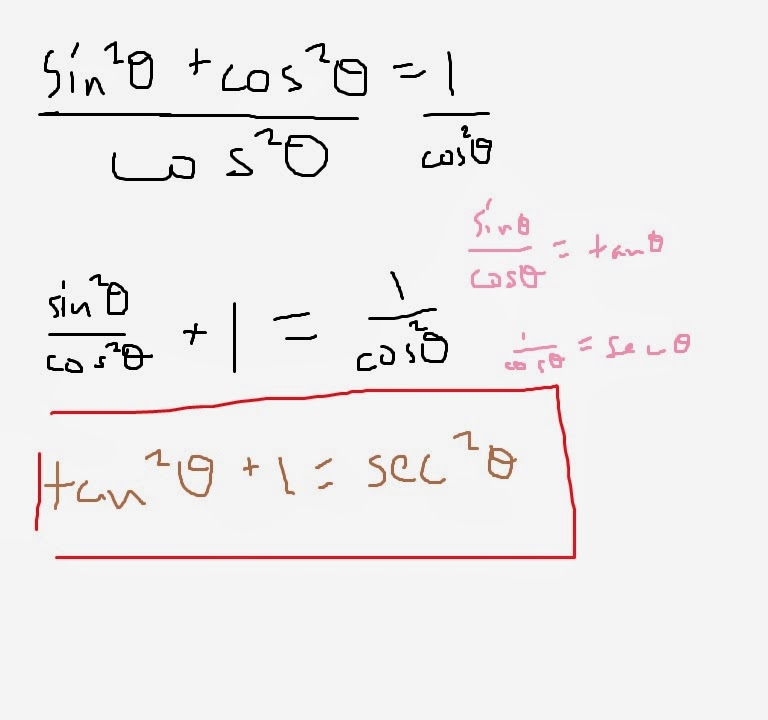
What you would basically do, is divide both sides by either trigonometric function, in order to create ratios that would equal other trigonometric functions. Meaning: you create different ratios by making either sine or cosine equal to 1.


Inquiry Activity Reflection:

1) "The connections I see so far between Units N, O, P, and Q so far are" that they all work together - the unit circle, angles, trigonometric functions, all that stuff - in order to make our experience in math class harder. They all made us critically think about what we are given, and helped us put the pieces of this conundrum together.

2) "If I had to describe trigonometry in THREE words, they would be": "Gotta go fast."

Tuesday, March 4, 2014

I/D #2: Unit O - How Can We Derive the Patterns For Our Special Right Triangles?

1) We may derive a 30/60/90 degree triangle's special pattern from an equilateral triangle with a side length of 1, by first dividing the triangle into two halves that are completely equal. You'd split it right in the middle, creating two triangles that share one side of the previously whole equilateral triangle (which equaled 1), and the side that was created by splitting them in half. They each have their own side of 1, across from the 90° angle that they both have, which was created by the division.


Since we divided the side which had previously equaled 1 into two equal parts, then each triangle must have a side of 1/2. So, if we proceed with that deduction, then that side, squared, added with the other side that's not the hypotenuse, squared, should equal the hypotenuse, squared. Basically, a² + b² = c² (Pythagorean Theorem), with 1/2 being a, the other leg being b, and 1 being c. This works because the triangles we had created, have 90° angles, and therefore, have an assumed hypotenuse across from them, along with the values for a and b that fit into the aforementioned equation. (1/2)² + b² = (1)² would be 1/4 + b² = 1, and subtracting 1/4 from both sides would result in 3/4 as the value for b². And, if we take the square root of the entire fraction, then it should equal √3/√4, which would reduce into √3/2.


Lastly, we'd have to save this extremely rare knowledge, by multiplying everything by 2, and then, by a variable, so that this pattern will be easily transferable to any 30/60/90 degree triangle. Multiplying each side by 2n, basically, would yield a hypotenuse of 2n, a value of n for the side across from the 30° angle, and a value of n√3 for the side across from the 60° angle. This pattern shall forever exist for any 30/60/90 degree triangle, since the pattern was derived from ratios that will be the same for all 30/60/90 degree triangles.


2) We may derive a 45/45/90 degree triangle's special pattern from a square with the equal sides of 1, by diagonally dividing two 90° angles (across from each other) exactly in half, and making four 45° angles - two for each triangle. Each triangle would then, each have two sides that equal 1, and share a hypotenuse.


So, since the two triangles that we have given life to have 90° angles, then the Pythagorean Theorem can be utilized in order to find the length of the hypotenuse in this set-up. 1² + 1² = c² shall become c² = 2, and from that point onward, be √2.


In order to again, preserve our newly-discovered and revolutionary (in the field of mathematics) pattern, we must multiply all of our triangles' values by n, in order to create a distinct pattern that we can follow for any 45/45/90° triangle. Everything just basically gets an n attached to it.


Inquiry Activity Reflection
1) Something I never noticed before about special right triangles is that their established patterns can be deduced from a logical procedure, instead of just being "there", because we were told that it happened to be "there".

2) Being able to derive these patterns myself aids in my learning because I'm not just remembering given facts or something - I'm actually finding out this stuff myself.

Monday, February 24, 2014

I/D #1: Unit N Concept 7 - How Do Special Right Triangles and the Unit Circle Relate?

Inquiry Activity Summary
1) The first and foremost part of interpreting a 30° special right triangle, is setting the side opposite of the 30° angle to x, and going along with that, the hypotenuse as 2x, and the other leg of the triangle as x3. In order to align this set-up with the unit circle, we must set the hypotenuse equal to 1, since the radius of a unit circle will always be 1, and the hypotenuse will be exactly between the Unit Circle's center and its arc. So, if we set the hypotenuse to 1, then we basically divide all of our previously-acquired values by 2x, making it proportionate to the 2x = 1 ratio that we had fabricated. So, the x would become 1/2, and the x3 would become 3/2.


2) In order to make sense of a 45° special right triangle, we should first set up the hypotenuse as x√2, and the other two sides as x (since both sides are the identical, according to geometry). To match this up with the unit circle, we set the hypotenuse to 1, which is most simply done, by dividing x√2 by x√2, which gives us 1. Dividing x by x√2 would make x times (1 / x√2), creating a situation in which the x's cancel out, and you are left with 1/√2. In order to rationalize that, you would multiply it by (√2 / √2), which would result in (√2 / 2) for your two other sides.


3) Lastly, the 60° special right triangle should include the exact same values as the 30° special right triangle would. All that one would have to do, is ensure that values accordingly match up with degrees. But, I suppose that I have enough time to explain this. Basically, the side opposite of your 60° angle would be set to x3, your hypotenuse set to 2x, and your other leg, set to x. In order to substantiate a hypotenuse equal to 1, you would divide all of the values by 2x, and end up with 1 for the hypotenuse, 3/2 for the side that had previously equaled x3, and 1/2 for the side that had previously been x.


4) How Does This Activity Help You To Derive The Unit Circle?
I suppose that this activity helped me more easily identify all of the values that encompass various common degrees in a unit circle, by listing out all of the possible values that I should know. If I were tasked to find out the coordinates of wherever any 30° or 60° angle's terminal side met with the Unit Circle's arc, there could only ever be three values that I need to know (their signs and or order depend upon which quadrant of the circle they are in): 1, 3/2, and 1/2. For the 45° angle, literally the only two values I would ever need to figure out coordinates of wherever the 45° angle's terminal side met with the unit circle's arc would be 1 and √2 / 2. This stuff is really useful in trigonometry and all.

5) The triangles drawn in this activity were in Quadrant I, ergo, their positive coordinates. The signs would change in differing quadrants, with Quadrant II implying a negative x-coordinate, Quadrant III, a negative x-coordinate and y-coordinate, and Quadrant IV, a negative y-coordinate.


Inquiry Activity Reflection
1) The coolest thing I learned from this activity was that from remembering three simple values (3/2, 1/2, and √2 / 2), you can get everything that you need in the Unit Circle. All you'd have to do is remember what different quadrants do to the signs of the values, and all that other stuff.

2) This activity will help me in this unit because I can now, more easily remember the Unit Circle.

3) Something I never realized before special right triangles and the unit circle is that just by identifying which side is the longest of the two of a 30° or 60° angle, you can determine which has the 3/2, and which is the 1/2 (3/2 is bigger than 1/2).